Rethinking Freshness Beyond the Cold Chain: Lessons from the 2026 Fridge Attacks
Three waves of attacks on store refrigeration in three months have shown how quickly a cold chain can fail. New trial data shows how Vidre+® active packaging gives crops that are usually stored cold more days outside the cold room.
No fresh produce supply chain can be prepared for everything. Power outages. Heatwaves. Pests. And now, cyberattacks.
On November 1 and 2, 2026, suspected cyberattacks hit refrigeration systems in supermarkets in at least nine European countries. Attackers switched fridges and freezers to defrost mode, so the units warmed up instead of cooling. In Sweden and Estonia, temperatures of up to 50°C (122°F) were reported. It was the third wave of attacks on store refrigeration in three months, after the United States in August and France in October.
Christophe Hansen, the European Commissioner for Agriculture and Food, called it “a deliberate attempt to disrupt our food supply chain and undermine consumers’ confidence in it.”
Each wave ended the same way. Food that could no longer be considered safe was removed from the shelves and thrown away.
Three Waves in Three Months: Supermarket Fridge Cyberattacks
In August, the target was at least six US military commissaries. In October, it was more than 350 supermarket sites in France. In November, stores in at least nine more European countries were hit, from Ireland to Estonia.
The method is not new. According to Reuters, hackers attacked supermarkets in Russia and Israel in the same way in 2022, and in 2024 a similar attack on a US meat facility destroyed more than 2,000 pounds (about 900 kg) of meat.
Why a Cold Chain Break Turns into Food Waste
When a store cannot confirm that food stayed at a safe temperature, it cannot confirm that the food is safe, so the food is thrown away. Fresh produce depends on the same cold rooms, and it keeps ripening and aging when cooling stops.
In Belgium, local media estimated the lost food at about €100,000. In France, the head of one retail chain spoke of “tens of millions of euros nationwide in a single day.” This adds to a problem that was already large: 45% of all fruit and vegetables are wasted, and fresh produce waste is forecast to cost $88 billion in 2026. Fresh Inset develops technology to reduce this waste.
A Second Layer of Freshness Management
Refrigeration is the backbone of the fresh produce supply chain. But a cold room depends on one controller, one network connection and one power supply. If one fails, the room starts to warm.
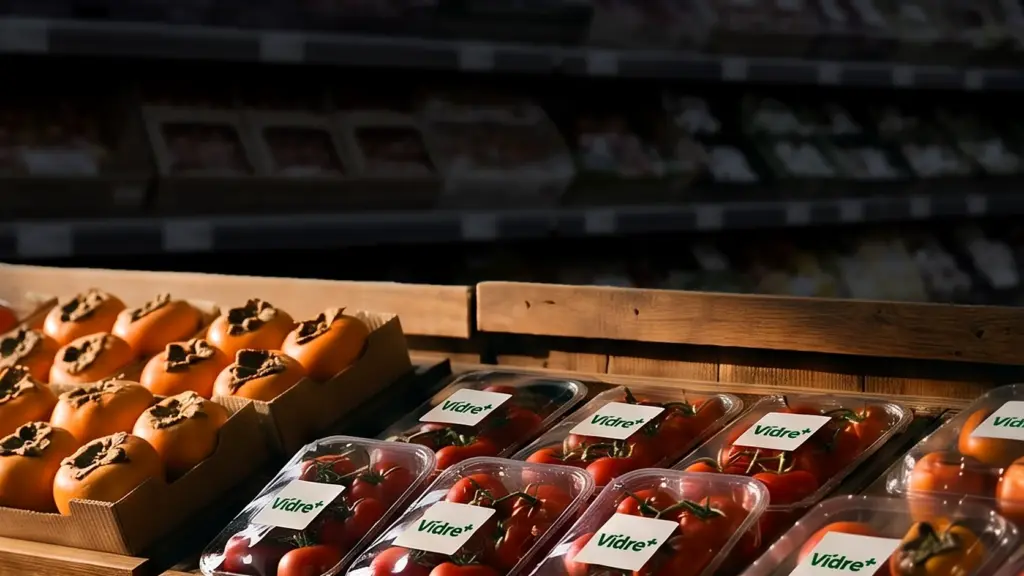
Resilient freshness management needs a second layer inside the package itself. Fresh Inset’s Vidre+® is active packaging of this kind: a quality maintaining system that works in each box, bag or clamshell, with no controller, network or power supply.
Which Crops Can Spend More Time Outside the Cold Room?
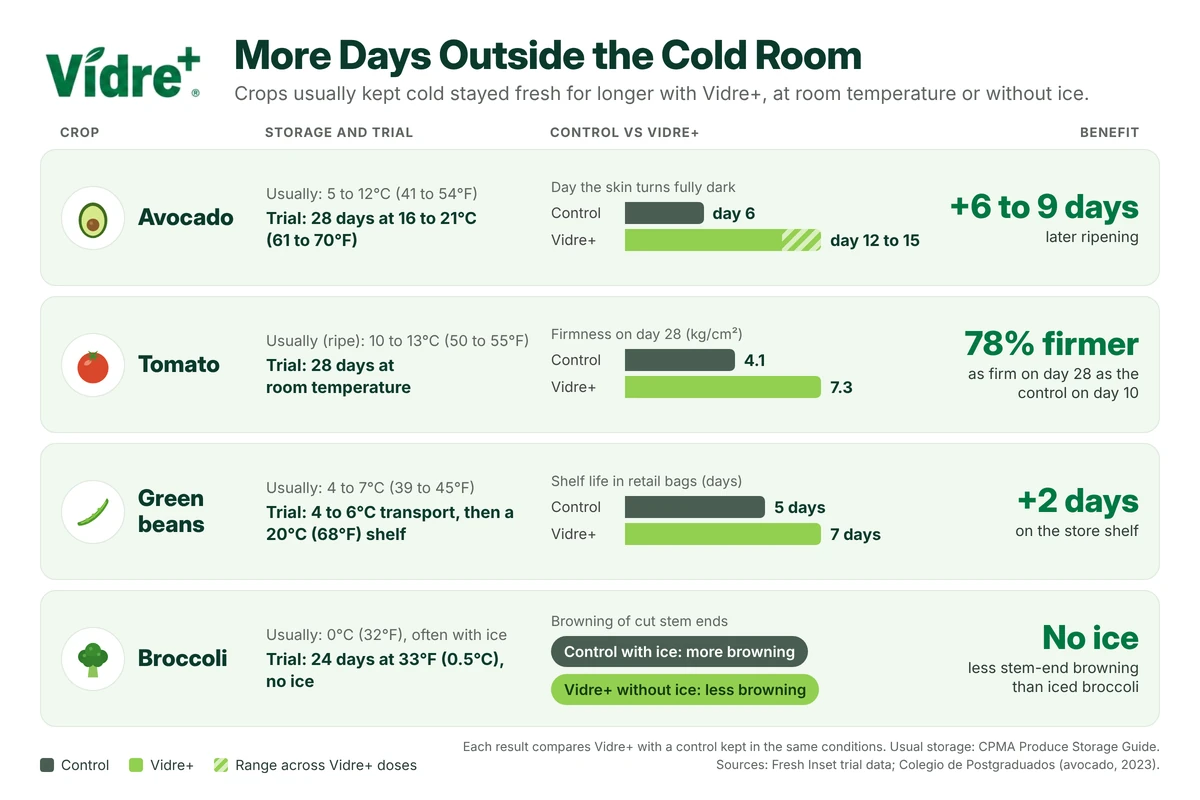
Many fruits and vegetables are stored cold as standard practice, at the temperatures listed in the storage guide of the Canadian Produce Marketing Association (CPMA). In Vidre+ trials, several of these crops stayed fresh for longer at room temperature, or without ice, than a control kept in the same conditions
. 
Avocados: Ripening Delayed by 6 to 9 Days
Avocados are usually kept in refrigeration at 4 to 7°C (39 to 45°F) for up to 28 days. A 2023 study by Colegio de Postgraduados tested Vidre+ in warmer conditions: 24 hours at 5°C (41°F), then 28 days at 16 to 21°C (61 to 70°F).
- Control fruit had fully dark skin by day 6. Fruit with Vidre+ reached the same color on day 12 to 15.
- The flesh of control fruit was fully dark by day 15. With Vidre+, this happened on day 21 to 24.
- From day 15 to day 28, fruit with Vidre+ was significantly heavier than control fruit.
The study concluded that Vidre+ slowed ripening at all three doses tested.
Tomatoes: As Firm on Day 28 as the Control on Day 10
Ripe tomatoes are often stored at 10 to 13°C (50 to 55°F). In an official trial in Mexico, tomatoes picked at color stage 3 were kept at room temperature for 28 days.
- On day 28, tomatoes with Vidre+ had a firmness of 7.3 kg/cm², the same as the control around day 10. By day 28, the control had dropped to 4.1 kg/cm².
- On day 21, weight loss was 11.7% with Vidre+ and 15.0% in the control.
Riper tomatoes (color stage 4) also stayed firm for longer: on day 28, Vidre+ fruit was as firm as the control on about day 21.
Green Beans: Two Extra Days on a 20°C Shelf
Green beans are usually stored at 4 to 7°C (39 to 45°F). In a 2026 test with a packer, Helda beans were transported at 4 to 6°C (39 to 43°F) and then placed on a 20°C (68°F) supermarket shelf.
- In retail bags, shelf life was 7 days with Vidre+ and 5 days in the current packaging. Bags with Vidre+ also showed less condensation.
- In bulk packs of topped beans, Vidre+ combined with a perforated bag reduced rot and mold by more than 50%.
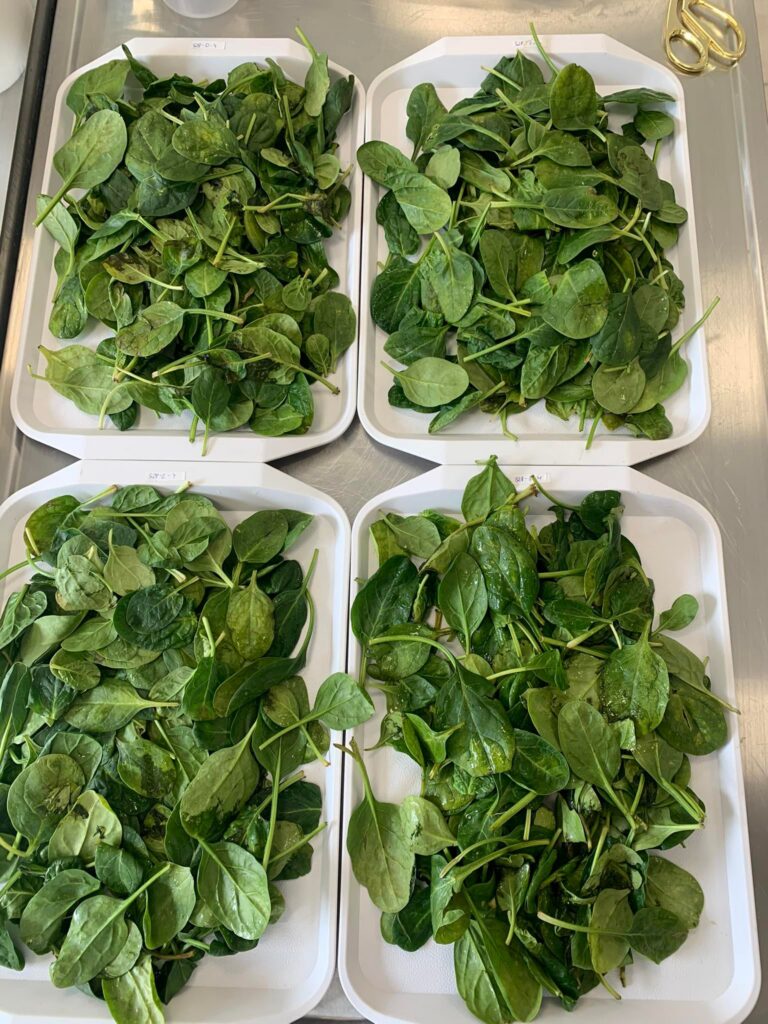
Broccoli: No Ice and Less Stem-End Browning
Broccoli is often packed with ice to keep it cold and fresh. Two 2026 trials tested Vidre+ without ice:
- In a 24-day commercial trial in the United States at 33°F (about 0.5°C), broccoli with Vidre+ and no ice showed less browning of the cut stem ends than iced broccoli, and its overall quality matched the iced control.
- In a trial in Spain with long-stem broccoli in boxes with a plastic liner, Vidre+ without ice was rated much better than the iced commercial control after 11 days at 3 to 5°C (37 to 41°F).
For packers and distributors, an ice-free cold chain means lighter boxes and no ice handling, with the same or better broccoli quality.
How Vidre+® Works
Vidre+ is active packaging technology for shelf-life extension. In simple terms:
- It is a small label or print placed inside the package.
- Humidity from the fresh produce activates it.
- It releases its active ingredient slowly and gradually for up to 30 hours. That is 7 times longer than traditional powder and sachet solutions.
- It helps prevent ethylene hotspots inside the package. Ethylene is the natural plant hormone that drives ripening.
- It fits into existing packaging: rigid lids, lidding films and cardboard inserts. No expensive equipment upgrades are needed.
What This Means for Growers, Distributors and Retailers
- Growers can harvest at optimal maturity, protect quality in transit and reach distant, higher-margin markets instead of selling only locally.
- Packers and distributors gain more time to ship and sell when logistics slow down.
- Retailers can reduce shrink, extend the selling window and keep produce looking fresh on the shelf.
Every Day of Freshness Counts
No supply chain can stop every attack, outage or heatwave. But every extra day of freshness is food that reaches a plate instead of a waste bin, and food waste reduction is a shared responsibility across the whole chain, from field to shelf.
Fresh Inset runs controlled trials with growers, packers, distributors and retailers, using their existing packaging. Contact the Fresh Inset team at freshinset.com to plan a pilot for a specific crop.

In controlled trials, avocados ripened 6 to 9 days later, tomatoes stayed firm much longer at room temperature, green beans gained 2 days on a 20°C (68°F) shelf, and broccoli without ice showed less stem-end browning than iced broccoli.
Vidre+ adds a second layer of post-harvest management on top of cold storage. It gives produce extra days of freshness when it spends time outside the cold room, and in broccoli trials it made ice unnecessary.
Humidity from the produce activates Vidre+, which then releases its active ingredient slowly and gradually for up to 30 hours. That is 7 times longer than traditional powder and sachet solutions.
No. Vidre+ fits into existing packaging, such as rigid lids, lidding films and cardboard inserts, so no expensive equipment upgrades are needed.
Sources
News reports
- Reuters via WHTC: Pentagon investigates military base freezer malfunctions as a suspected cyberattack, October 29, 2026
- TIME: Cyberattack on supermarket refrigeration in France, October 13, 2026
- The Star / AFP: Fridge cyberattack hits supermarkets across Europe, November 3, 2026
- Irish Times: Supervalu removes frozen and chilled food from 13 stores after cyber attack on fridges, November 2, 2026
- Euronews: Cyberattack hits Belgian supermarket fridges and freezers, November 2, 2026
Storage standards
Fresh Inset data
- Colegio de Postgraduados (2023): Biological effectiveness evaluation of Vidre+ on avocado, Mexico
- Fresh Inset: Official tomato trial, Mexico
- Fresh Inset: Green bean shelf-life test, 2026
- Fresh Inset: Broccoli trial summary, 2026
- Fresh Inset: Vidre+ Combo-Deck 2026 (food waste figures and technology data)