
Vidre+® Table Grapes Maintain Marketable Quality for Approximately 5 Days Longer
CASE STUDY | POST-HARVEST TABLE GRAPES WITH VIDRE+ TECHNOLOGY
Multi-country post-harvest trials show an average extension of marketable life by approximately 5 days.
Key results at a glance
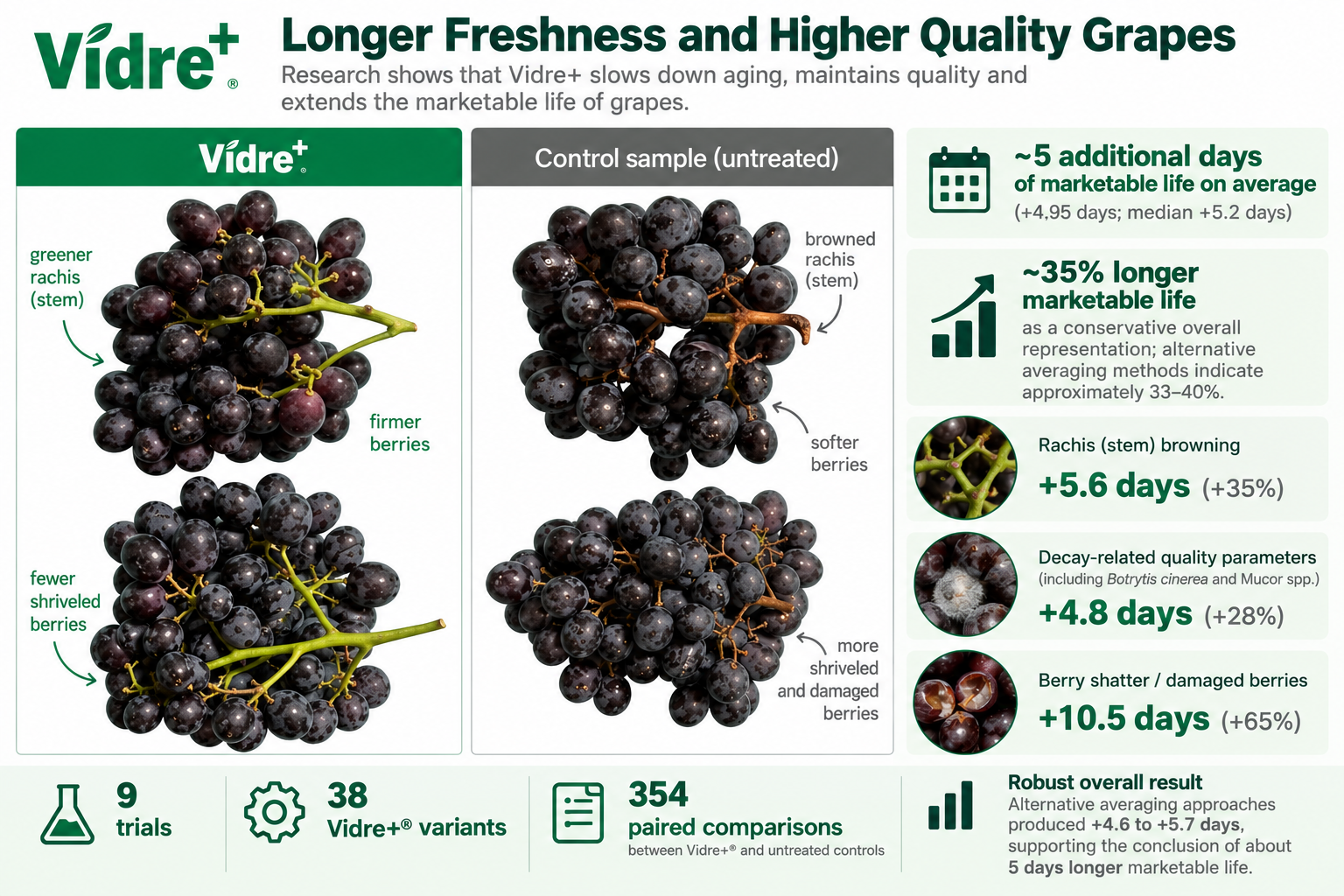
- ~5 additional days of marketable life on average (+4.95 days; median +5.2 days).
- ~35% longer marketable life as a conservative summary of the overall results; alternative averaging methods indicate approximately 33–40%.
- +5.6 days for rachis (stem) browning (+35%).
- +4.8 days for decay-related quality parameters, including Botrytis cinerea and Mucor spp. (+28%).
- +10.5 days for berry shatter and damaged berries (+65%).
- 9 trials, 38 Vidre+® variants and 354 paired comparisons between Vidre+® and untreated controls.
- Robust overall result: alternative averaging approaches produced +4.6 to +5.7 days, supporting the conclusion of approximately 5 additional days of marketable life.
The challenge: maintaining table grape quality after harvest
Table grapes face a demanding journey after harvest. Depending on their origin and destination, they may spend several weeks in cold storage before entering distribution and retail channels. During this period, deterioration can become visible through rachis browning, fungal decay, berry shatter and berry damage.
These factors directly affect whether grapes remain commercially acceptable and appealing to consumers.
To evaluate whether Vidre+® could extend this marketable window, a series of post-harvest trials was carried out between 2022 and 2026 in Italy, Greece, Spain and the United Kingdom. The programme covered commercial varieties including Italia, Soultanina, Aledo, Dominga and Sweet Celebration, as well as different storage and packaging conditions such as standard boxes, intact and perforated films, and retail flow-wrapped punnets.
The result: around 5 additional days of marketable quality for grapes
Across the 38 Vidre+® variants included in the analysis, treated grapes maintained comparable marketable quality for an average of 4.95 days longer than untreated controls. In relative terms, the mean improvement was 40%; because alternative methods of averaging produce values between approximately 33% and 40%, “approximately 35% longer” provides a conservative overall representation of the results.
Vidre+®-treated table grapes remained in good marketable condition for approximately 5 days longer than untreated grapes.
Importantly, this conclusion reflects the complete evidence base rather than a selection of only the most promising outcomes. Both positive and negative comparisons were retained in the analysis, providing a balanced overall estimate across the trials. The conclusion was also stable under different calculation approaches: equal weighting per trial produced +4.6 days, pooling all 354 comparisons produced +5.7 days, and the median result across variants was +5.2 days.
Performance across key table grape quality parameters
Rachis browning: +5.6 days
The appearance of the rachis is one of the most immediate visual indicators of table grape freshness. Across the analysed trials, Vidre+® extended the time to an equivalent level of rachis browning by an average of 5.6 days, or 35%.
Berry shatter and damage: +10.5 days
The largest calculated improvement was observed for berry shatter and damaged berries. Vidre+® delayed the onset of an equivalent level of deterioration for this parameter by 10.5 days on average, representing a 65% increase compared with untreated controls.
Decay: +4.8 days
For decay parameters associated with Botrytis cinerea and Mucor spp., the calculated average extension was 4.8 days (+28%).
From post-harvest quality to commercial opportunity
An additional five days of marketable quality can represent a meaningful extension of the commercial window for table grapes. For growers, packers, exporters and retailers, maintaining quality for longer may provide greater flexibility across cold storage, transport, distribution and retail display. In particular, delaying visible quality deterioration can help grapes remain commercially attractive later in the supply chain.
A UK retail-punnet trial provides a consumer-facing perspective. Assessors were asked whether they would buy the grapes based on their appearance. In this trial, Vidre+® extended the calculated period of saleability by 1.6 days (+28%). The trial authors’ own estimate of “potentially 2 days extra life” was consistent with the calculated result.
A broad evidence base across European growing regions
The overall analysis draws on nine trials used for the main calculation, conducted in Italy, Greece, Spain and the United Kingdom between 2022 and 2024. They represented different grape varieties, storage periods, temperatures and packaging systems.
The diversity of the programme tested Vidre+® under a range of post-harvest scenarios. Because trial designs differed, the results were combined through a common time-to-equal-quality approach. Crucially, the headline result is based on the complete set of qualifying comparisons—including less favourable outcomes—not only on the strongest-performing trials.
How the shelf-life extension was calculated
The individual trial reports did not directly state a figure for “additional shelf-life days”. Instead, the extension was derived from quality measurements collected at successive assessment dates using a time-shift (time-to-equal-quality) model.
The model determined how much later Vidre+®-treated grapes reached the same degree of deterioration as untreated grapes. Commercially relevant parameters included rachis browning, Botrytis incidence, Mucor incidence and berry shatter or damage. Where Vidre+® performed worse than the control, the resulting negative gain was included rather than removed from the average.
Conclusion
Across a diverse programme of European post-harvest trials, Vidre+® demonstrated the potential to extend the marketable life of table grapes by approximately 5 days—or around 35%—compared with untreated grapes.
The analysis covered 38 Vidre+® treatment variants and 354 paired quality comparisons, with benefits observed across key parameters including rachis browning, decay and berry integrity. The headline result reflects all qualifying trial data, including less favourablecomparisons, and remained consistent across alternative averaging methods.
Vidre+® can help table grapes remain in good marketable condition for about 5 days longer.
Trials and reports included in the review
The analysis was based on trial reports from the FRESH INSET GRAPES project.
1. Italy 2022 – Italia
Italy_Grapes_A22-716-720XE_2-22-VITVI-IT01.pdf — Agri 2000, 2022
2. Italy 2023 – Italia
Italy_Grapes_A23-727-746FE_2-23-VITVI-IT01.pdf — Agri 2000, 2023
3. Italy 2024 – Italia (organic)
Italy_Grapes_SCR-EFF-061-2024-01.pdf — Agrigeos, 2024
4. Greece 2023 – Soultanina
Greece_Grapes_AGR23-175-746FE_2-23-VITVI-GR01.pdf — Agri 2000, 2023
5. Spain 2022 – Aledo
Spain_Grapes_AES22-121-720XE_2-22-VITVI-ES01.pdf — Agri 2000 Iberia, 2022
6. Spain 2023 (a) – Aledo
Spain_Grapes_EU-23-2286-01_2-23-VITVI-ES01.pdf — Syntech Research, 2023
7. Spain 2023 (b) – Dominga
Spain_Grapes_EU-23-2287-01_2-23-VITVI-ES02.pdf — Syntech Research, 2023
8. Spain 2023 (c) – Aledo
Spain_Grapes_SI23TC001ES01.pdf — SICOP, 2023
9. United Kingdom 2024 – Sweet Celebration
UK_Grape_trial_7_technical_report.pdf — Greenbean Scientific, 2024
Additional qualitative evaluations reviewed: Italy_Grapes_Aug_2024.pdf and Italy_Grapes_Sept_2024.pdf —
Janssen PMP evaluation sheets, 2024; qualitative only and not included in the main calculation.